
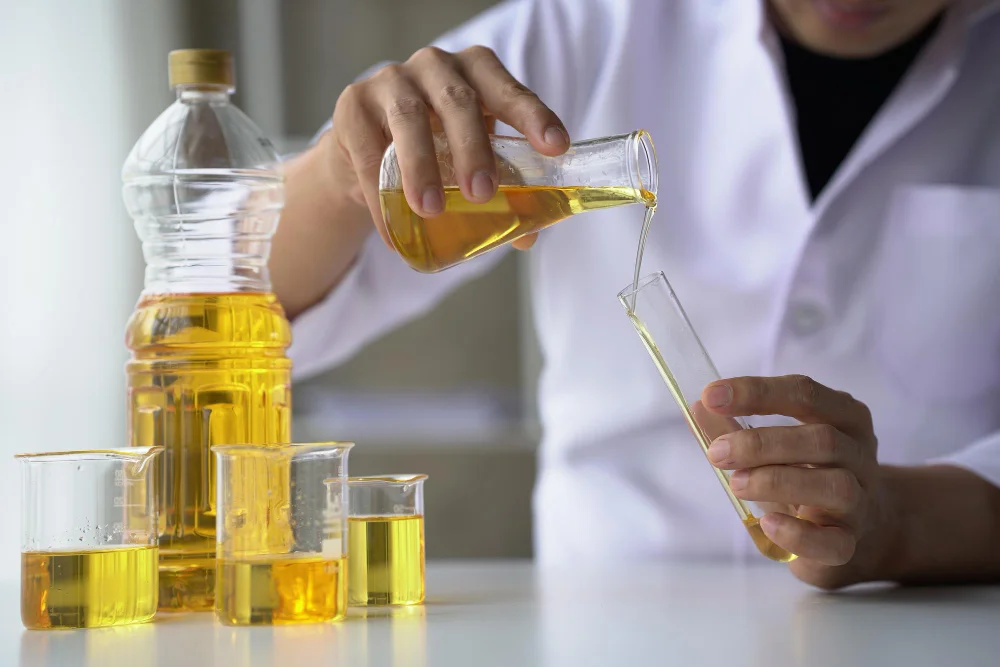
Ever wondered how refiners know a diesel fuel will protect your engine’s pump and injectors? The HFRR test for diesel fuel gives the answer. It rubs a steel ball against a steel disk in a small diesel sample and measures the wear mark left behind. A smaller mark means better lubricity and a longer life for the fuel system.
At Innoveda Chemicals, we treat it as a basic quality check for anyone buying, storing, or using diesel in the UAE.
What Is the HFRR Test for Diesel Fuel?
HFRR stands for High-Frequency Reciprocating Rig. It is a laboratory method, described in standards such as ISO 12156-1 and the ASTM D6079 HFRR standard, that checks how well diesel protects metal surfaces under boundary lubrication. This is the situation where the fluid film is too thin to keep moving parts fully apart.
The method applies to middle distillate diesel fuels and to biodiesel blends. It gives a single measurable number, the wear scar diameter, which makes it easy to compare one fuel against another or against a specification.
How Poor Diesel Lubricity Impacts Engines and Injectors
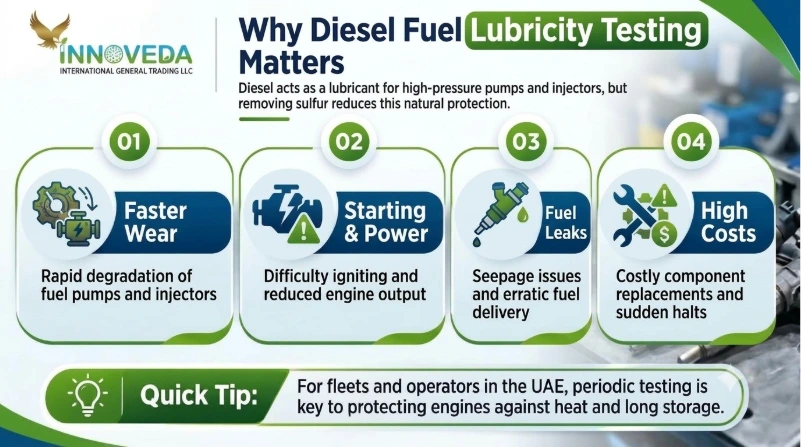
Diesel is more than a fuel. In many engines, it is also the only lubricant for the high-pressure pump and injectors. Removing sulfur during refining also removes some natural compounds that gave diesel its slippery quality. That makes diesel fuel lubricity testing important for ultra-low-sulfur grades.
Poor lubricity can lead to:
- Faster wear on pumps and injectors
- Hard starting and loss of power
- Fuel leaks and inconsistent injection
- Expensive repairs and unplanned downtime
For fleets, generators, and storage operators in the UAE, a test result is an objective way to judge fuel before problems appear. Hot weather and long storage can also affect fuel quality, so periodic checks make sense.
One honest note: lab results can be affected by trace contamination during sampling and storage. Standards also say a perfect link between HFRR numbers and field performance has not been established. Treat the test as a reliable guide, not a guarantee.
HFRR Test Procedure: How the Test Works
The HFRR test procedure is simple in principle and strict in practice. A technician places a small fuel sample in a reservoir and heats it to the test temperature. A vibrating arm holding a non-rotating steel ball is lowered onto a steel disk submerged in the fuel. The ball moves back and forth under a fixed load, then the technician measures the scar on the ball under a microscope and corrects the result for lab humidity.
| Parameter | Typical condition |
| Sample volume | 2 mL |
| Test temperature | 60 °C (25 °C is an alternative) |
| Applied load | 200 g |
| Stroke and frequency | 1 mm at 50 Hz |
| Duration | 75 minutes |
| Result reported | Wear scar diameter (micrometres) |
Clean glassware, careful sampling, and controlled conditions are essential. Small errors in handling can change the result.
How to Read HFRR Test Results
Wear scar size is what matters most, and a tighter mark points to stronger lubrication. These are commonly used reference points at 60 °C:
| Wear scar diameter | What it means |
| Up to 460 µm | Meets the stricter EN 590 limit, good lubricity |
| 461 to 520 µm | Meets the ASTM D975 limit but not EN 590 |
| Above 520 µm | Poor lubricity; treatment and retesting advised |
Always confirm which specification your engine maker, buyer, or contract requires. Different markets can apply different limits.
Using Lubricity Additives to Restore Diesel Fuel Quality
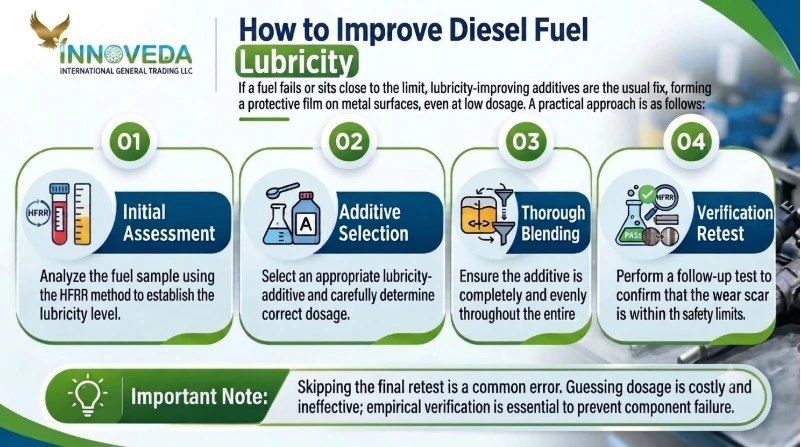
If a fuel fails or sits close to the limit, lubricity-improving additives are the usual fix. They form a protective film on metal surfaces, even at low dosage. A practical approach looks like this:
- Test the base fuel with the HFRR method.
- Choose a suitable additive and follow the dosage guidance.
- Mix it thoroughly into the fuel.
- Retest to confirm the wear scar is now within the required limit.
Leaving out the retest is the biggest mistake. Dosage that is too low won’t fix the problem, and guessing is costly.
Where to Find a Diesel Gurd NB Liquid Supplier in Dubai
If you are looking for a reliable diesel gurd nb liquid supplier in dubai, Innoveda Chemicals can help. Innoveda International General Trading operates as a UAE-based chemical supplier with proper certification. It serves industries such as oil refining, food, and water and sewage treatment, with both raw materials and consumer products.
Before buying any fuel treatment, review the product page and ask for technical data and usage guidance so you know it suits your fuel and application. You can also explore the full range at Innoveda Chemicals.
Conclusion
The HFRR test for diesel fuel is a fast, standardised way to check whether diesel can protect pumps and injectors from wear. A small wear scar means good lubricity, while a large one is a warning sign. Understanding the test, reading the results against the right limit, and retesting after treatment can save you from costly repairs. For fuel-treatment chemicals and expert support in Dubai, Innoveda Chemicals is ready to help.
FAQs
1. What does HFRR stand for in diesel fuel testing?
HFRR stands for High-Frequency Reciprocating Rig. It is a laboratory test that measures diesel fuel lubricity by rubbing a steel ball on a disk and checking the wear scar left behind.
2. What is a good HFRR result for diesel?
A wear scar of 520 micrometres or less at 60 °C meets ASTM D975, while 460 micrometres or less meets the stricter EN 590 limit. Lower numbers mean better lubricity and less pump wear.
3. Why is lubricity important in diesel fuel?
Lubricity protects fuel pumps and injectors from metal-to-metal wear. Good lubricity extends component life, keeps injection accurate, and reduces breakdowns and repair costs, especially in modern high-pressure diesel engines.
4. How is the HFRR test done?
A 2 mL fuel sample is heated to 60 °C. A loaded steel ball vibrates against a submerged steel disk for 75 minutes, and technicians then measure the wear scar under a microscope.
5. Can additives fix poor diesel lubricity?
Yes, lubricity-improving additives can bring a failing fuel back within limits. Dosage matters, so retest the treated fuel with the HFRR method to confirm the result.