
- Agriculture:
- Fertilizer: Urea is primarily used as a nitrogen fertilizer in agriculture. It provides a high concentration of nitrogen (46% N), which is essential for plant growth, promoting lush foliage and increasing crop yields.
- Slow-Release Formulations: Urea can be used in slow-release fertilizers, which help reduce nitrogen loss to the environment and improve nutrient efficiency.
- Industrial Applications:
- Chemical Manufacturing: Urea is used as a raw material in the production of various chemicals, including formaldehyde, melamine, and other nitrogen-containing compounds.
- Resins and Plastics: It is utilized in the manufacturing of urea-formaldehyde resins, which are used in the production of adhesives, laminates, and molded plastics.
- Pharmaceuticals:
- Medical Uses: Urea is used in certain medical formulations, particularly in dermatological products, as it helps to hydrate and exfoliate the skin.
- Nitrogen Source: It is also utilized in certain laboratory procedures and pharmaceutical applications as a nitrogen source.
- Animal Nutrition:
- Feed Supplement: Urea is added to ruminant animal feeds as a non-protein nitrogen source. Ruminants can utilize urea for protein synthesis, promoting growth and production in livestock.
- Water Treatment:
- Wastewater Treatment: Urea is used in some wastewater treatment processes to promote the growth of microorganisms that help break down organic matter.
- Textiles:
- Dyeing and Finishing: In the textile industry, urea is used in dyeing processes and fabric finishing to improve the quality and performance of textiles.

Urea
Urea, also called carbamide (because it is a diamide of carbonic acid), is an organic compound with chemical formula CO(NH2)2. This amide has two amino groups (–NH2) joined by a carbonyl functional group (–C(=O)–). It is thus the simplest amide of carbamic acid.
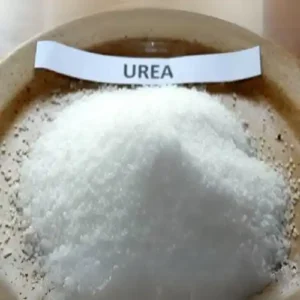
Urea is a colorless, crystalline organic compound with the chemical formula CO(NH₂)₂. It is one of the most widely used nitrogenous fertilizers globally and plays a crucial role in agriculture and various industrial applications. Urea is produced synthetically through the Haber-Bosch process, resulting in a highly soluble nitrogen source that provides essential nutrients for plant growth.
Urea is a vital compound with diverse applications, particularly in agriculture, where it serves as a key nitrogen source for promoting plant health and productivity. Its multifunctional nature extends beyond farming into various industrial and pharmaceutical sectors, making it a crucial ingredient in numerous formulations and processes.
| Appearance | White crystalline solid |
| Odor | White solid |
| pH | 8.0 to 9.0 |
| Molecular Weight | 60.06 g/mol |
| Boiling Point | decomposes |
| Melting Point | 133 to 135 °C |
| Vapor Pressure | 0.0001 mmHg at 25°C |
| Density | 1.32 g/cm3 |
| Flash Point | Non-flammable |


Reviews
There are no reviews yet.