
- Chemical Manufacturing: Caustic soda is a key ingredient in the production of various chemicals, including detergents, soaps, and synthetic fibers. It's used in processes such as neutralization and saponification.
- Pulp and Paper Industry: It’s used in the kraft process for wood pulping, where it helps break down lignin and separate cellulose fibers. This is a critical step in paper production.
- Water Treatment: Caustic soda is used to adjust the pH of water and wastewater, helping to neutralize acidic conditions and facilitate the removal of impurities.
- Aluminum Production: In the Bayer process for refining bauxite ore into aluminum oxide, caustic soda is used to dissolve aluminum-containing minerals and separate them from impurities.
- Food Industry: It is used in food processing, including in the production of certain food additives and as a pH adjuster in various food products.
- Cleaning and Maintenance: Caustic soda is used in industrial cleaning applications to remove grease, fats, and oils. It’s also used in the production of heavy-duty cleaners and degreasers.
- Petrochemical Industry: It is used in the refining process and for various reactions in petrochemical production.
- Textile Industry: In textiles, caustic soda is used in the processing of cotton and other fibers, including in the mercerization process to improve their strength and dye uptake.
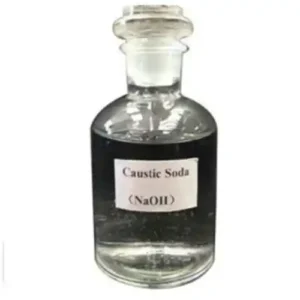
Caustic Soda Liquid 48% to 50%
Sodium hydroxide, also known as lye and caustic soda,[1][2] is an inorganic compound with the formula NaOH. It is a white solid ionic compound consisting of sodium cations Na+ and hydroxide anions OH−.
Sodium hydroxide is a highly corrosive base and alkali that decomposes lipids and proteins at ambient temperatures and may cause severe chemical burns. It is highly soluble in water, and readily absorbs moisture and carbon dioxide from the air. It forms a series of hydrates NaOH·nH2O.[11] The monohydrate NaOH·H2O crystallizes from water solutions between 12.3 and 61.8 °C. The commercially available “sodium hydroxide” is often this monohydrate, and published data may refer to it instead of the anhydrous compound.
As one of the simplest hydroxides, sodium hydroxide is frequently used alongside neutral water and acidic hydrochloric acid to demonstrate the pH scale to chemistry students.[12]
Sodium hydroxide is used in many industries: in the making of wood pulp and paper, textiles, drinking water, soaps and detergents, and as a drain cleaner.
Caustic soda, or sodium hydroxide (NaOH), is a highly versatile and widely used industrial chemical. In its liquid form, it's often referred to as "caustic soda liquid" or "sodium hydroxide solution." Here are some common industrial applications:
| CAS Number | 1310-73-2 |
| Chemical formula | NaOH |
| Molar mass | 39.9971 g/mol |
| Appearance | White, opaque crystals, Liquid |
| Odor | odorless |
| Density | 2.13 g/cm3[4] |
| Melting point | 323 °C (613 °F; 596 K)[4] |
| Boiling point | 1,388 °C (2,530 °F; 1,661 K)[4] |
| Solubility in water | 418 g/L (0 °C) |
| 1000 g/L (25 °C)[4] | |
| 3370 g/L (100 °C) | |
| Solubility | soluble in glycerol, negligible in ammonia, insoluble in ether, slowly soluble in propylene glycol |
| Solubility in methanol | 238 g/L |
| Solubility in ethanol | <<139 g/L |
| Vapor pressure | <2.4 kPa (20 °C) |
| 0.1 kPa (700 °C) | |
| Acidity (pKa) | 15.7 |
| Magnetic susceptibility (χ) | −15.8·10−6 cm3/mol (aq.)[5] |
| Refractive index (nD) | 1.3576 |


Reviews
There are no reviews yet.